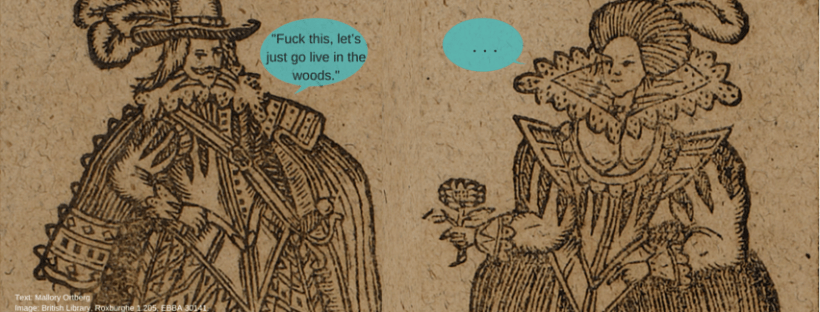
“Alexis to Lesbia” by Alexander Craig of Rosecraig

I recently learned about another response to Marlowe’s “The Passionate Shepherd to His Love” that I did not find in my preliminary research (oh, so long ago it seems). 

Dr. James Reid-Baxter, Scottish Historian, informed me of a Scottish reply published in 1606 entitled “Alexis to Lesbia” by Alexander Craig of Rosecraig. Rosecraig, located in Banff, is an ancient port on the Moray Firth Coast. Craig published his “rich tribute” to quote the words of Dr. Reid-Baxter, to the ballad towards the end of “The amorose songes, sonets, and elegies: of M. Alexander Craige, Scoto-Britane,” printed at London, 1606 STC (2nd ed.) / 5956. This book is available on EEBO (Early English Books Online) database. As a subscription is required to access the database, I have the first page of the reply available for viewing here:

http://gateway.proquest.com.libaccess.sjlibrary.org/openurl?ctx_ver=Z39.88-2003&res_id=xri:eebo&rft_id=xri:eebo:citation:99840995

Alexis to Lesbia by Alexander Craige

The poem begins with familiar words: “Come be my Love, and live with me.” Below is some commentary on the work from Dr Reid-Baxter, posted here with his permission:

It is quite particularly interesting because Craig, who was trying to make a name as a court poet in London, actually sets his poem in Banff (without naming the town) by his reference to the river “Doveran” (now spelled Deveron) running into the sea, and much evocation of that element and the rocky coastline to the west of Banff. The poem’s various references to rocks are almost certainly a pun on Craig’s own surname (which is a variant of English “crag”). Also interesting is the fact that Craig uses the ballad as the first part of a whole dramatic sequence of addresses and replies–with the exception of the “sonnet to Lesbia”, these can all be sung to “the tune”, whatever that tune was in 1606. 

The tune may very well be Live with me and be my love! After speaking with Erik Bell, Music Specialist for EBBA and a contributor for this site, I have learned that all of the Alexis-Lesbia dialogue ballads can be sung to the Live with me and be my Love tune. We are doing some digging to see what else can be found about the tune.

While comparing this reply to the three versions of Marlowe’s ballad (published in The Passionate Pilgrim, 1599, in the England’s Helicon, 1600, and the Roxburghe Collection, 1619-1629?), I was surprised at the length of “Alexis to Lesbia” (1606)! It has 14 stanzas, more than twice the amount of all three versions of “The Passionate Shepherd to His Love.” It is also the only one of the Alexis-Lesbia dialogue ballads that is in the same stanza format as Marlowe’s ballad. It’s rhyme scheme is also AA BB, the same as “The Passionate Shepherd to His Love.” However, “Alexis to Lesbia” does not feature a refrain at the end of each stanza. Another response in the Alexis-Lesbia dialogue ballads collection, “A Letter to Lesbia, showing his discontent,” evokes again the Marlowe ballad lines: “Oft have I pray’d thee be my Love,/Come live with me, and thou shalt prove.” 


You can read more about Alexander Craig of Rosecraig through the Oxford Dictionary of National Biography (subscription required).

When I add information to the website or write these blog posts, I try to use as many digital and online accessible sources. The sad truth is there aren’t that many about this work. Those that I have found require subscriptions to databases.

A Sacred Parody of the Passionate Shepherd: Melville and Marlowe

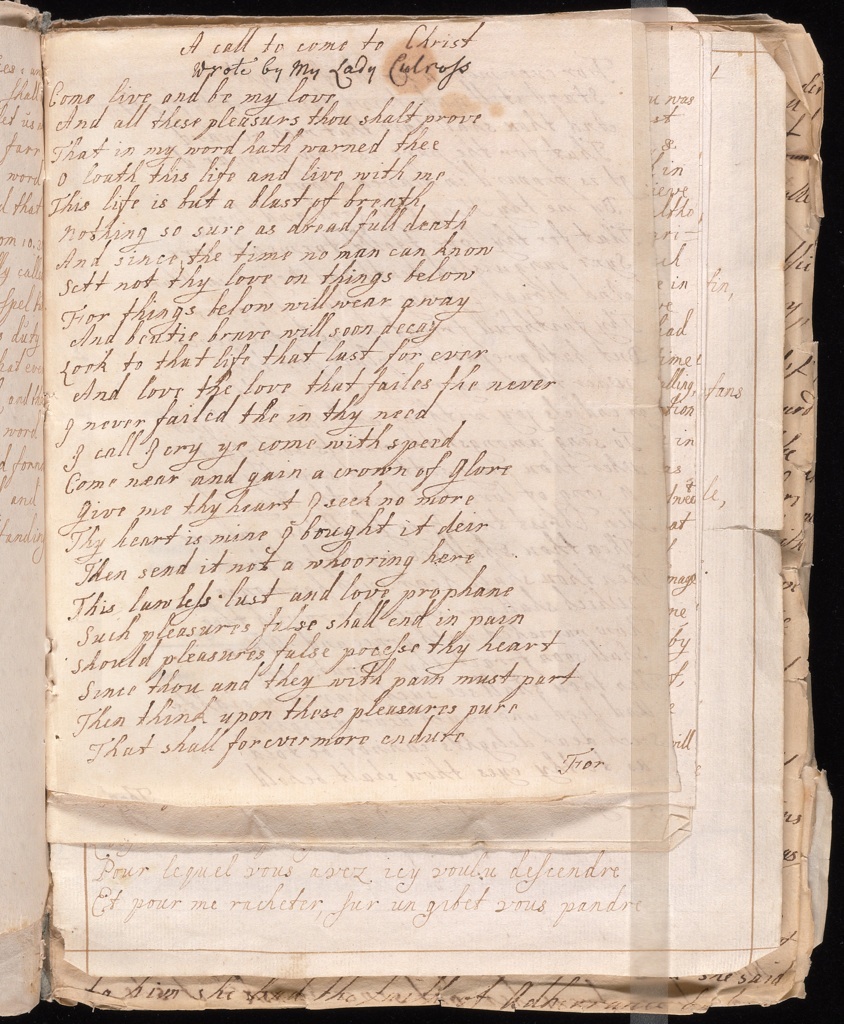
This week I learned about another 17th-century parody of Christopher Marlowe’s “The Passionate Shepherd to His Love” written by the Scottish religious poet Elizabeth Melville (Lady Culross) entitled “A Call to Come to Christ.” Elizabeth Melville (c.1578-c.1640) was a Scottish presbyterian devotional poet. She is celebrated as the first Scottish woman to have her poetry appear in print, and is the author of a significant body of poetry in manuscript. You can read more about her life here, Elizabeth Melville Biography.

You can look at the facsimile images and read the transcriptions of “A Call to Come to Christ” on the Early Modern Women’s Research Network (EMWRN). The EMWRN is an Australian-based network of scholars which aims to bring the often institutionally-isolated scholars of early modern women’s writing into dialogue with others in the field, both within Australia and internationally. The Material Cultures of Early Modern Women’s Writing Digital Archive presents online editions of women’s writing that circulated in a variety of forms in the sixteenth and seventeenth centuries. This Digital Archive is fabulous because most of the texts presented were not printed in actual editions. Thanks to the EMWRN, they are available!

melville_call_01-lowres

“A Call to Call to Come to Christ” from the Reinecke Rare Book and Manuscript Library, Yale University, Boswell Collection, Gen MSS 89, Series XV, Box 105, Folder 1925, item 5.


I am enormously grateful to Dr Sarah Ross, Senior Lecturer of English, Film, Theatre and Media Studies at Victoria University of Wellington, New Zealand, for contacting me and informing me about this wonderful 17th-century parody. You can read all about Elizabeth Melville’s poetry in Dr Sarah Ross’ Women, Poetry, and Politics in Seventeenth-Century Britain (2015). 

A New Look at Christopher Marlowe’s “The Passionate Shepherd to His Love”

Christopher Marlowe’s ballad “The Passionate Shepherd to His Love” is probably one of the most well-known poems or, as Mallory Ortberg calls it, “The Most Frequently Owned-Upon Poem In History.” In class we learn about Marlowe’s pastoral love poem but we barely scratch the surface of the complicated and fascinating history surrounding this poem. From directly after its first printing to modern-day, the poem has inspired responses in all genres of literature, art, and music. Its manifestations include a broadside ballad, newspaper comics, jazz songs, poetic parodies and replies, as well as paintings and textile works of art. I have found that there is no one place where this information has been cultivated.

Come Live With Me homepageTo fill this gap, I have created Come Live With Me: Living the History of a Ballad. The site is now live and available for free to anyone who wants to know more about the literary life of Christopher Marlowe’s “The Passionate Shepherd to His Love.” Continue reading

Ballad Recording Session

Today I learned just how difficult it is to record a song.

IMG_1771

Music Building at UCSB

After walking me down flights of stairs,  Erik Bell,  the Singing Team Manager at EBBA, took me to ( what is known as “The Dungeon” to EBBA singers) the old Ethnomusicology Laboratory in the UCSB Music Building. It’s a small room; the walls are filled with shelving full of cassette tapes, VHS’s, old TV’s, and record players. The technology and decor made me feel as though I had stepped back in time to the 1970’s. The mic was set up, pointed away from the ceiling vent, and the small table where the computer and the Focusrite Scarlett 2i4 audio interface machine was sat less than 5 feet away. I was nervous. Never one keen to be in the spotlight, the idea of singing with an audience (even of just one) made me incredibly anxious. 

Marlowe’s ballad, of course, is tricky and no stanza is exactly the same. Whether it’s lines with more words, fewer words, odd stresses, whatever, it made keeping the tempo difficult. One line, “A hony tongue, a heart of gall” took me forever to get right. I kept stressing “A” when I should have been stressing “hony”: “A ho-ny tonguea heart of gall” instead of “A ho-ny tongueheart of gall. Continue reading

New Quarter Update

It’s been a few months since I refocused the project and began creating this WP site. Since then I have been getting the advice from professors at UCSB. I have been collaborating with the Early Modern Center at UCSB as well as the English Broadside Ballad Archive. James Kearney, my Renaissance Studies major advisor and past-professor, and Megan Palmer-Browne, Assistant Director of EBBA, have been a help since the beginning of my project. Also on board is Eric Bell, Singing Team Manager at EBBA, and Patricia Fumerton, the Director of EBBA. They will be helping me as collaborators and editors of the site. Continue reading

A New Lens

The title of this post has to do with refocusing,  not changing the direction one is looking but changing the focus a bit. I’ve done a bit of refocusing on this project. In the beginning, it was to be a 20+ page paper and now it has become so much more. Not a paper with page after page of criticism, analysis, facts, and citations, but a space that gives information as well as encouraging ongoing interaction. This site exists to honor what Christopher Marlowe’s poem is all about: inspiring, reflecting, and creating.

The site is not live yet. Less than half the pages have anything written on them and those are not even completed. This post will also be private until the site itself is live. However, the documentation of my research is an essential part of this project.

I will using the blog part of this site for all the documentation. Any videos or recordings will also be posted on here.


Written by Jessica Sparks
This post was originally written February 27, 2016
Come Live With Me: Living the History of a Ballad